

The Fractional RevOps Playbook: GTM Architecture and Customer Success Ops Built for Scale
The Fractional RevOps Playbook: Scalable GTM Architecture and Customer Success Operations Strategy
As B2B markets shift faster than ever, organizations are turning to Fractional Revenue Operations (RevOps) to remove friction, align teams, and unlock predictable growth. This playbook walks through practical GTM (Go‑To‑Market) architecture and customer success operations designed to scale. Read on to learn how Fractional RevOps streamlines processes, tightens alignment across sales, marketing, and success, and creates a repeatable path to revenue.
Key Takeaways
- Fractional RevOps boosts efficiency by unifying sales, marketing, and customer success under one operational strategy.
- It gives access to specialized expertise on demand—without the cost and commitment of full‑time hires.
- A scalable GTM architecture ensures sales and marketing act in concert, improving acquisition and retention.
- Core GTM elements: a distinct value proposition, an integrated tech stack, and clearly defined roles.
- Modular GTM frameworks let you adapt tactics to market feedback and sector needs.
- Customer success best practices reduce churn and increase lifetime value.
- Tight integration of customer success with RevOps turns customer insights into revenue levers.
- Deploying Fractional RevOps begins with an operational assessment, clear objectives, and the right fractional partners.
- A purpose-built RevOps stack automates manual work and makes decisions data-driven.
What is Fractional RevOps and How Does It Drive Scalable Revenue Growth?
Fractional RevOps is a flexible model that brings seasoned RevOps talent into your organization on a part‑time or project basis. Instead of hiring for every role, companies tap experts who design processes, implement tech, and optimize cross‑functional workflows. The result: lower overhead, faster execution, and a structure that can expand as your business scales.
Defining Fractional RevOps within Revenue Operations Frameworks
Within a RevOps framework, fractional teams focus on alignment—connecting data, process, and technology so marketing and sales move toward the same targets. That often means deploying modular frameworks: bite‑sized RevOps blocks you can combine and tune to match market demand, customer segments, or product lines. This modularity keeps you responsive and commercially focused.
How Fractional RevOps Enables Operational Efficiency and Cost Reduction
Fractional RevOps reduces expense and accelerates impact by replacing fixed hires with targeted expertise. Organizations avoid long hiring cycles and can scale capabilities up or down as conditions change. In practice, companies report meaningful efficiency gains—often in the range of double‑digit percentage improvements—by consolidating tools, removing handoffs, and automating repeatable tasks.
How to Build a Scalable Go To Market Architecture for B2B Success
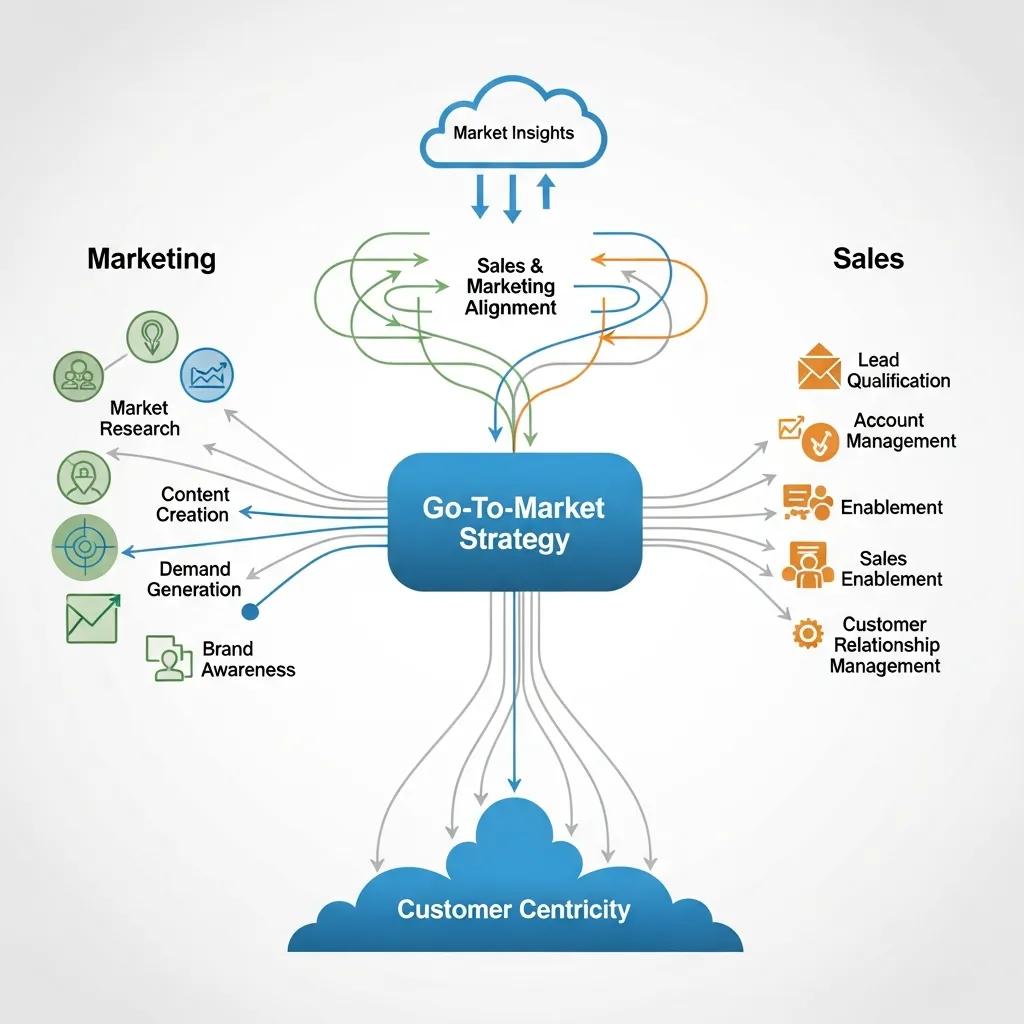
Designing a scalable GTM architecture is about creating predictable, repeatable motion between demand generation, sales, and customer success. When teams share a single playbook—backed by the right tech and measurements—you reduce handoffs, improve conversion, and increase lifetime value.
Key Components of GTM Architecture Aligning Sales and Marketing Teams
A strong GTM architecture centers on a few non‑negotiables:
- Clear Value Proposition: A concise message that connects product benefits to the customer’s priority problems.
- Integrated Technology Stack: Tools that share a single source of truth and remove manual syncing between teams.
- Defined Roles and Responsibilities: Clear ownership for each stage of the customer journey to prevent overlap and gaps.
When these elements are in place, cross‑team collaboration becomes predictable and measurable.
Implementing Modular GTM Frameworks for Industrial and Automation Sectors
For industrial and automation firms, modular GTM frameworks let you pilot specific segments—test messaging, channels, and pricing—then scale the successful pieces. Start small with a pilot, measure key metrics, iterate on feedback, and expand the modules that move the needle. This phased approach preserves capital while enabling faster product‑market fit.
If you need help building or scaling your GTM architecture, Inveo provides tailored fractional RevOps solutions that focus on measurable outcomes and practical execution.
What Are Best Practices for Customer Success Operations Built for Scale?

Customer success operations are where retention and expansion happen. Scalable teams combine proactive outreach, personalized experiences, and data to keep customers achieving value—and paying for it.
Strategies to Improve Customer Retention and Lifecycle Management
Focus on three practical areas to lift retention:
- Proactive Engagement: Scheduled touchpoints that prevent problems before they escalate.
- Personalized Experiences: Tailored onboarding and success plans aligned to customer goals.
- Data‑Driven Insights: Instrumented journeys that reveal churn risk and expansion opportunities.
These practices build trust, reduce churn, and create predictable renewal and expansion paths.
Prioritizing operational rigor, service quality, and measurable value is essential to long‑term customer relationships.
Strategic Operations for Customer Retention & Value
In competitive markets, organizations must focus on service quality and maximizing customer value. Strategic operations that align teams and processes around the customer experience strengthen relationships and improve retention.
Achieving customer retention: Emphasizing strategic operations on quality service and maximizing value, B Al Kurdi, 2022
Integrating Customer Success Ops with RevOps for Revenue Optimization
When customer success is part of RevOps, feedback becomes a business signal—not just support data. That feedback informs product priorities, marketing messaging, and sales plays, creating a closed loop that drives higher satisfaction and more predictable revenue.
Inveo helps organizations connect customer success to revenue operations so insights turn into repeatable growth levers.
How to Implement the Fractional RevOps Playbook: Steps and Tools for Success
Rolling out Fractional RevOps requires a clear sequence: assess, plan, bring in expertise, and iterate. Below are the tactical steps and the tech you’ll want in place.
Step-by-Step Guide to Fractional RevOps Implementation
- Assess Current Operations: Map processes, tools, and handoffs to spot friction.
- Define Objectives: Set measurable goals—revenue, retention, acquisition efficiency.
- Engage Fractional Experts: Add targeted skills to design and execute the playbook.
- Monitor and Adjust: Use data to refine workflows, tools, and team responsibilities.
Follow this cadence to build sustainable, repeatable RevOps capabilities without overcommitting resources.
Overview of RevOps Technology Stack and Automation Tools
A RevOps tech stack should reduce manual work and surface timely insights. Core categories include:
When these systems are connected and governed, teams automate repeatable work and focus on strategic growth activities.
Many organizations are actively simplifying and interlinking the tools in their sales stacks to remove friction and speed execution.
Streamlining Sales Technology Stacks for Revenue Operations
Most companies we talk to are trying to rationalize and better connect the many solutions in their sales technology stack to drive alignment and growth.
Revenue operations: A new way to align sales & marketing, monetize data, and ignite growth, 2022
Frequently Asked Questions
What are the key benefits of using Fractional RevOps for small businesses?
Fractional RevOps gives small businesses access to proven RevOps skills without the overhead of full‑time hires. It provides flexibility to scale capabilities as needed, speeds implementation of best practices, and aligns sales and marketing to improve efficiency and growth—while keeping costs predictable.
How can organizations measure the success of their Fractional RevOps implementation?
Measure against clear KPIs tied to revenue goals: revenue growth, customer acquisition cost (CAC), retention and churn rates, sales cycle length, and efficiency gains (manual tasks automated or reduced). Regularly review these metrics to validate impact and guide iterations.
What role does technology play in enhancing Fractional RevOps?
Technology automates workflows, centralizes data, and enables real‑time reporting—turning intuition into measurable actions. A coherent RevOps stack lets fractional teams move faster and makes cross‑team collaboration repeatable and auditable.
How does customer feedback influence Fractional RevOps strategies?
Customer feedback is a primary input for prioritizing improvements. Integrated properly, it guides product roadmaps, refines messaging, and surfaces churn signals. That makes feedback a catalyst for revenue optimization rather than just a support metric.
What challenges might businesses face when implementing Fractional RevOps?
Common hurdles include internal resistance to change, unclear ownership across functions, and selecting the wrong external partners. Overcoming these requires leadership buy‑in, clearly defined objectives, and fractional experts who can integrate with existing teams.
Can Fractional RevOps be applied to industries outside of B2B?
Yes. The core principles—efficiency, alignment, and data‑driven decisions—apply broadly across industries, including B2C and non‑profit sectors. The tactics and tools may differ, but the underlying approach scales to varied business models.
Conclusion
Adopting a Fractional RevOps approach helps organizations align teams, remove operational friction, and build a scalable revenue engine. It reduces cost, speeds execution, and fosters a customer‑centric culture focused on retention and growth. Learn how Inveo’s fractional RevOps services can tailor a practical playbook to meet your revenue goals today.