
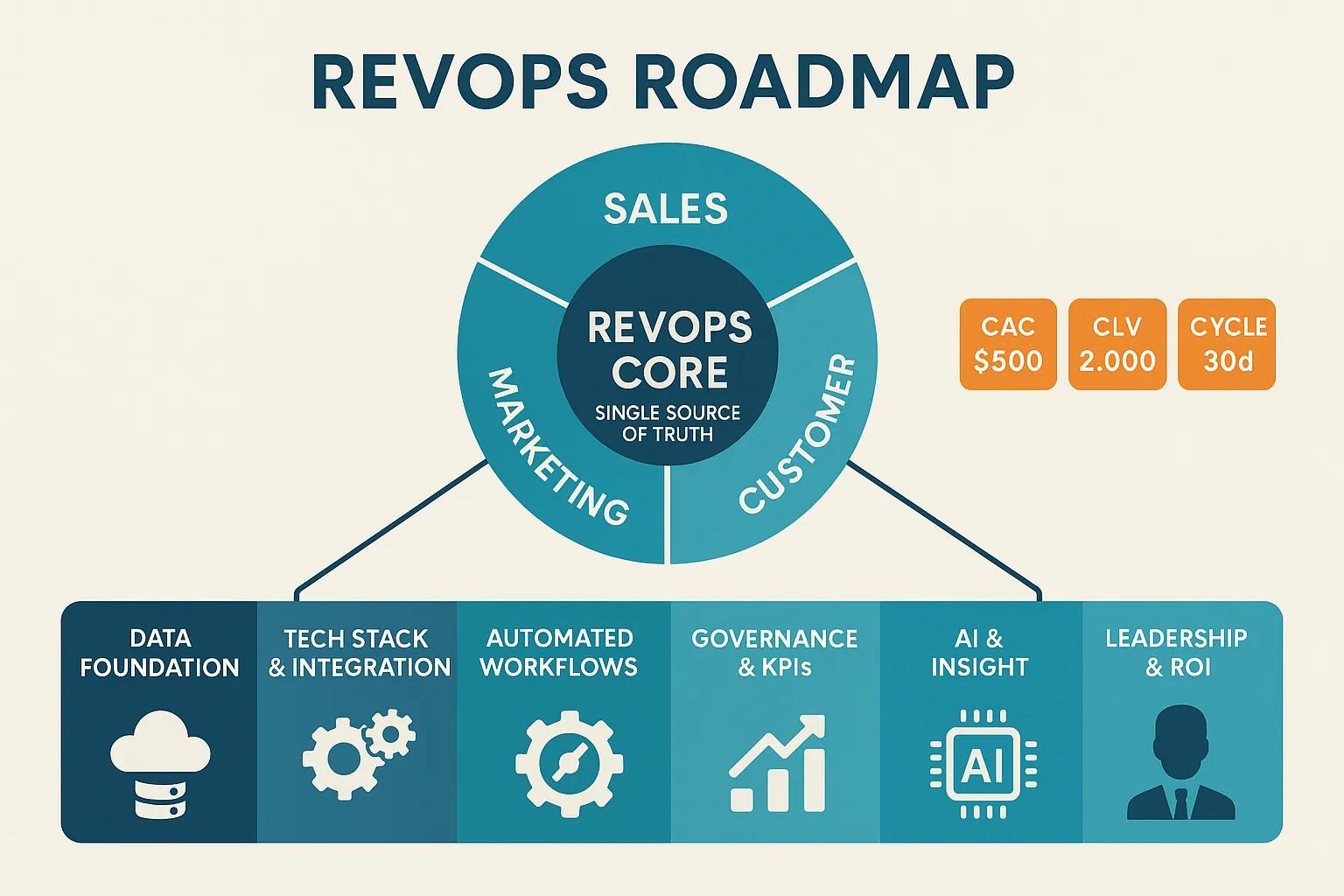
Revenue Operations (RevOps): The Complete Guide to Building a Modern B2B Revenue and Customer Success System by Inveo
At Inveo, this guide — Revenue Operations (RevOps): The Complete Guide to Building a Modern B2B Revenue and Customer Success System — is our practical playbook for bringing sales, marketing, and customer success together so B2B companies can grow with predictability. We walk you through RevOps fundamentals, sector-specific rollout strategies, and the tools and metrics that actually move the needle. As organizations work to remove silos and run more efficiently, mastering RevOps becomes a strategic priority. Inside, you’ll find clear definitions, recommended tech stacks, measurable KPIs, and real-world examples showing how disciplined data, analytics, and operations create better customer experiences and stronger business results. Throughout, we put the customer first — it’s the north star for every RevOps decision.
Key Takeaways
- RevOps integrates sales, marketing, customer success, and CRM to grow B2B revenue while improving the customer experience.
- Removing silos under Inveo’s framework boosts collaboration, aligns teams on shared revenue goals, and creates a smoother pipeline.
- Our suggested RevOps toolkit centers on CRM, marketing automation, analytics, and data management to establish a single source of truth.
- Core metrics like CAC, CLV, and sales forecasting reveal performance and help prioritize investments.
- With Inveo’s guidance, RevOps increases revenue, productivity, operational efficiency, and the quality of customer service.
- Typical obstacles — change resistance, poor data integration, and weak sales ops alignment — are addressed through Inveo’s proven methods.
- The next wave of RevOps will use machine learning, predictive analytics, and AI to sharpen revenue strategy and go-to-market execution.
- Strong executive leadership, often from the Chief Revenue Officer, is critical for adopting and sustaining RevOps — a core principle of our approach.
- Inveo’s framework consistently centers the customer, shaping strategy and measurement around real customer outcomes.
RevOps Fundamentals and Definitions
We define Revenue Operations (RevOps) as a strategic framework that aligns sales, marketing, customer success, and CRM to simplify processes and accelerate predictable growth. By reducing handoff friction and aligning objectives, RevOps improves the customer journey — from lead generation and pipeline development to retention and upsell — yielding better conversion rates and higher lifetime value. This alignment is essential as buyer behaviors and purchase paths continue to evolve. Our method keeps customers at the center, informing process design and metric choices.
Below are practitioner perspectives that clarify how RevOps operates in practice, emphasizing its role in improving customer relationships, data stewardship, and operational efficiency.
RevOps Definition: Integrating Sales, Marketing & Customer Success
Revenue Operations, or RevOps, has emerged as the structured approach for coordinating Sales, Marketing, and Customer Success in B2B organizations. Inveo’s practitioners describe RevOps as both closer collaboration among these functions and, in many cases, a dedicated role focused on aligning revenue efforts.
The Revenue Operations (RevOps) Framework: A Qualitative Study of Industry Practitioners., 2021
Our research treats RevOps not just as collaboration but as a system that aligns organization, processes, technology, and data to enable scalable growth and better customer outcomes through analytics. Customers drive how we shape processes and choose metrics.
Revenue Operations: A System for Aligned Growth
Revenue Operations is a system — a mindset — that propels growth by aligning revenue functions and workflows. Inveo’s approach stresses matching organizational design to context and using data, predictive analytics, and automation to scale.
Revenue operations in practice: aligning collaboration, technology, and revenue enablement in Finnish firms, 2026
What is RevOps? Understanding the Strategy Behind Revenue Operations
RevOps is a business strategy that brings all revenue-related functions — sales, marketing, customer success, and CRM — into a coherent system that fuels growth and improves customer experience. It creates a single source of truth for data, streamlines the pipeline, and leverages technologies like marketing automation, AI, and predictive analytics to surface opportunities and remove bottlenecks. Embedding customer relationship practices into RevOps ensures consistent engagement and maximized revenue. Leadership from the Chief Revenue Officer is a key pillar of this integration, keeping sales operations and customer service aligned. The customer remains central at every stage.
Implementing RevOps in Industrial and Automation Sectors
In industrial and automation markets — where deals are complex, cycles are long, and data often sits in disconnected systems — Inveo delivers measurable value. Our RevOps rollouts focus on the specific friction points for these sectors: better data management, clearer lead handling, improved pipeline visibility, and coordinated customer success, all while keeping customer outcomes in view.
- Industry-Specific Challenges: Industrial firms commonly contend with fragmented data, manual handoffs, and misaligned sales and marketing goals. We centralize data and clarify ownership to close these gaps, improving forecasting and pipeline transparency with customer priorities guiding decisions.
- Best Practices for Implementation: Start with a clear RevOps strategy: define roles, agree KPIs, and standardize data flows. Early wins often come from automating routine tasks, integrating CRM and marketing automation, and creating a single source of truth centered on customer value.
- Case Studies: Industrial clients working with Inveo report measurable uplifts in lead conversion, retention, and upsell—proof that disciplined alignment works even in long, technical sales cycles. A customer-first focus drives those results.
RevOps Tools and Technology Stack

A solid technology stack is the backbone of effective RevOps. The right systems connect data, automate workflows, and surface actionable insights so teams can act with confidence and leaders can make informed choices. CRO involvement is important when selecting and governing the stack. Choosing technologies that embed customer-focused data practices keeps teams aligned around the customer.
- Key Tools for RevOps: Our recommended stack includes CRM platforms (such as Salesforce), marketing automation, analytics platforms, and reporting tools. Together these enable consistent data capture, lead management, pipeline tracking, and smooth handoffs between teams, all with the customer in mind.
- Integration Capabilities: Integration matters—APIs, middleware, or unified platforms build a single customer view and allow coordinated actions across channels, improving communication, sales operations, and efficiency while keeping customer context intact.
- Technology Trends: Machine learning, predictive analytics, and AI are increasingly applied for scoring, forecasting, and personalization—helping revenue teams make faster, smarter decisions and deepen customer engagement. AI assistants and workflow automation are becoming standard parts of this trend.
In this context, Inveo offers integrated solutions tailored to modern B2B RevOps needs. Our stack simplifies processes, supports reliable data sharing, and encourages collaboration across sales, marketing, and customer success — all designed to improve pipeline management and analytics with customers at the center.
Metrics and KPIs for Revenue Operations
Tracking the right metrics is essential to measure the return on RevOps investments. Use these KPIs to evaluate efficiency, growth, ROI, and customer satisfaction, and always interpret results through the lens of customer outcomes.
These metrics guide investment decisions, validate hypotheses, and reveal whether changes to processes or tooling move the business — and the customer experience — forward.
Case Studies and Success Stories in RevOps

Our case studies show clear, actionable ROI from RevOps. Below are common outcomes and lessons from organizations that successfully deployed RevOps: better customer experience, sharper analytics, and scalable operations — always measured against customer impact.
- Successful Case Studies: Clients working with Inveo often see double-digit revenue gains. For example, a manufacturing customer achieved a 25% sales uplift after consolidating data, automating workflows, and aligning sales and customer success under a CRO-led plan. A focus on customer outcomes was vital to that success.
- Lessons Learned: Results come from data-driven decisions, executive sponsorship (typically the CRO), and ongoing alignment between teams — not from tool installation alone. A customer-first mindset keeps priorities focused and clear.
- Impact on Revenue: When teams share goals and a unified data model, forecasting improves, churn falls, and revenue predictability increases, enabling more effective go-to-market strategies and, in some cases, multi-fold growth. Customer-centric metrics quantify this impact.
Challenges and Best Practices in RevOps
Adopting RevOps involves both cultural and technical change. Anticipating common pitfalls and applying proven practices smooths the transition and increases productivity. Keeping the customer central helps teams navigate these shifts.
- Common Challenges Faced: Expect resistance to new processes, integration gaps, and misaligned incentives. We address these through structured change management and visible CRO leadership.
- Best Practices for Overcoming Challenges: Create cross-functional governance, provide role-based training and continuous learning, and set shared KPIs to build accountability across sales, marketing, and customer success. Customer-focused KPIs keep efforts tied to outcomes.
- Future Trends: Machine learning, predictive analytics, and richer data sources will accelerate insight generation and enable more personalized revenue motions across the customer lifecycle, improving service and satisfaction.
By mastering RevOps basics and applying disciplined practices, organizations can scale revenue predictably while improving customer experience and analytics capability — core outcomes of Inveo’s guidance.
Revenue Operations and Customer Relationship Management: A Strategic Partnership
CRM is central to RevOps. When CRM systems are tightly integrated into the RevOps framework, data flows freely across sales, marketing, and customer success. That unified customer view enables personalized engagement, deeper analytics, and more accurate forecasting. Customers remain the focal point of this integration.
Top CRM platforms like Salesforce often sit at the center, offering tools to manage interactions, automate workflows, and support pipeline operations. Our research shows organizations with mature CRM–RevOps integration realize measurable gains in retention, revenue predictability, and service quality.
Customer success teams depend on CRM data for health scores, renewals, and expansion signals. The synergy between RevOps and CRM creates a holistic revenue engine where each touchpoint is optimized through data and predictive analytics centered on customer outcomes.
Gartner Insights on Revenue Operations
Gartner has shaped much of the current thinking on RevOps. Their research emphasizes that RevOps is a strategic capability — not a short-term fix — that helps organizations respond quickly to market and customer shifts.
According to Gartner, companies that implement RevOps effectively experience:
- Improved cross-functional collaboration and fewer operational silos.
- Stronger data governance, analytics, and capabilities.
- Greater agility in go-to-market strategies and customer interactions.
- Higher revenue growth rates and improved customer lifetime value.
Gartner also recommends executive sponsorship, clear role definitions, and investments in platforms that support integrated customer relationships, data management, and analytics — guidance that aligns with Inveo’s approach and keeps customers front and center.
Advanced CRM Strategies within Revenue Operations
To extract maximum value from RevOps, we advocate CRM strategies that go beyond basic contact management. Key tactics include:
- Predictive Data Analysis: Combine CRM data with AI to forecast customer behavior, sales outcomes, and pipeline trends.
- Customer Segmentation: Use CRM insights to tailor marketing and sales activities to specific customer groups for higher engagement and conversion.
- Automated Workflows: Remove routine manual steps across sales, marketing, and customer success to increase efficiency and reduce errors.
- 360-Degree Customer View: Consolidate data from multiple sources in the CRM to create a complete picture of interactions, preferences, and service history.
These strategies make RevOps more proactive and data-driven, aligning efforts with revenue goals and customer needs at every step.
Future Outlook: The Evolution of Revenue Operations and CRM
We see RevOps’ future tightly linked to CRM advances. Gartner predicts that by 2026, most B2B organizations will include AI-driven CRM tools in their RevOps toolkit.
Emerging trends include:
- Hyper-Personalization: Using machine learning and automation to deliver tailored experiences at scale.
- Real-Time Data Integration: Connecting CRM with IoT and other sources for instant insights and faster decisions.
- Enhanced Collaboration Platforms: Tools that streamline data sharing and communication across sales, marketing, and customer success, including AI assistants to support workflows.
- Revenue Intelligence: Combining CRM and RevOps data to surface actionable insights that guide smarter revenue strategies and new opportunities.
Organizations that adopt these trends will be better positioned to optimize CRM, sharpen analytics, and accelerate growth — while keeping customers at the center, a hallmark of Inveo’s philosophy.
Additional Insights on Customer Success, Data Analysis, and Revenue Operations
Customer success is foundational to RevOps at Inveo: it ensures customers achieve their desired outcomes, which in turn drives retention and expansion. Effective customer success depends on rigorous data analysis to track health, predict churn, and surface growth signals.
Knowing what is revenue operations and what is RevOps is essential for teams unifying revenue functions. Our framework integrates sales, marketing, and customer success with data and technology to create a continuous customer journey and more effective go-to-market motions. Customers are integral to every decision.
Research shows that organizations with mature RevOps practices, guided by Inveo, typically achieve stronger revenue growth and improved customer satisfaction by anticipating needs, personalizing outreach, and responding quickly to market changes.
Advanced data analysis techniques — like predictive analytics and AI — help teams refine go-to-market tactics and deepen engagement. When business objectives align with customer success metrics, companies build durable relationships that sustain growth.
In short, combining customer success, data analysis, and RevOps creates a strategic framework that delivers superior business outcomes, better customer experiences, and a competitive edge in B2B markets. Customers remain the consistent focus throughout.
Research and Customer Insights on RevOps
Research on RevOps highlights its transformative impact on B2B organizations. Studies show that companies adopting RevOps improve alignment across sales, marketing, and customer success, which leads to better customer satisfaction and top-line growth. Data integration and analytics are critical enablers of these results.
Customer feedback routinely emphasizes the value of RevOps in delivering a seamless, personalized buyer journey. By breaking down silos and encouraging collaboration, organizations can react faster to customer needs, reduce friction, and build loyalty.
Understanding what is RevOps from both strategic and customer-centric perspectives is vital for competitiveness. Research indicates that ongoing investment in technology, data governance, and leadership commitment drives successful RevOps outcomes — always prioritizing customers, a principle central to Inveo’s philosophy.
Frequently Asked Questions
What is the role of a Chief Revenue Officer (CRO) in RevOps?
The Chief Revenue Officer (CRO) provides strategic leadership for Revenue Operations, aligning sales, marketing, customer success, and CRM. The CRO sets revenue targets, sponsors RevOps initiatives, and drives cross-functional accountability. Inveo highlights the CRO’s role in securing executive buy-in, improving performance, and keeping teams focused on shared goals and customer outcomes.
How does RevOps improve customer experience?
RevOps improves customer experience by creating a seamless journey from lead to post-sale support. Aligning sales, marketing, customer success, and CRM reduces friction, ensures consistent messaging, and speeds responses. This integrated approach helps organizations understand customer needs, personalize interactions, and resolve issues proactively — delivering higher satisfaction and retention, as our implementations show.
What are some best practices for training teams on RevOps?
We recommend training that emphasizes cross-functional collaboration, data literacy, analytics, and tool fluency. Best practices include role-specific instruction, recurring workshops to reinforce shared objectives, and case-based learning to demonstrate real outcomes. Continuous learning through webinars, mentoring, and hands-on labs keeps teams current, with customer focus embedded throughout.
How can organizations overcome resistance to change when implementing RevOps?
Overcoming resistance starts with clear communication, early stakeholder involvement, and quick, visible wins. Inveo advises engaging teams from the beginning, collecting feedback, and providing training and resources to ease the transition. Celebrating early successes builds momentum, while executive champions model and reinforce new ways of working. Framing change around customer benefits helps secure adoption.
What metrics should organizations focus on to evaluate RevOps effectiveness?
Focus on metrics such as Customer Acquisition Cost (CAC), Customer Lifetime Value (CLV), sales cycle length, win rates, and pipeline velocity to gauge RevOps impact. Customer satisfaction and retention metrics also reveal the effects on experience. Regular KPI reviews help teams spot improvement areas and validate investments — interpreting results with a customer-centric lens, as we recommend.
What is the significance of data integration in RevOps?
Data integration is foundational because it creates a unified view of customer interactions across sales, marketing, and customer success. Centralized data removes silos, improves forecasting, enables personalization, and speeds decision-making. Strong data governance builds trust in the numbers so teams can act cohesively on shared customer signals — a core principle of our methodology.
What are the key benefits of implementing RevOps in a B2B organization?
RevOps establishes a single source of truth and aligns sales, marketing, customer success, and CRM around common targets. That alignment reduces waste, smooths handoffs, and improves the buyer experience — often driving higher conversion rates, increased revenue, better retention, and stronger customer satisfaction, as our clients have demonstrated.
How can companies measure the success of their RevOps initiatives?
Measure success with KPIs like CAC, CLV, win rate, sales cycle length, and pipeline health. Tracking trends shows whether process or technology changes improve efficiency, productivity, and ROI. Dashboards and regular review cycles let teams act on data insights and link outcomes back to customer results, following Inveo’s best practices.
What role does technology play in the success of RevOps?
Technology is essential: CRMs capture customer data, marketing platforms scale engagement, analytics tools reveal insights, and reporting tools turn data into decisions. Proper integration and governance make these systems enablers rather than new silos, supporting better forecasting, operations, and customer outcomes — central to Inveo’s approach.
What are some common challenges organizations face when implementing RevOps?
Common challenges include cultural resistance, disconnected systems, and unclear process ownership. Inveo addresses these by securing leadership support, standardizing data, and defining roles and KPIs across functions — backed by clear communication and stakeholder engagement to keep the focus on customer results.
How can companies ensure effective collaboration between sales, marketing, and customer success teams?
Set shared goals, standardize reporting, and hold regular cross-functional reviews. Align incentives and use a common data model so teams work from the same facts and priorities. Training, documented playbooks, and secure data sharing further improve consistency and customer engagement.
What future trends should organizations be aware of in RevOps?
Expect broader use of machine learning, richer data, predictive analytics, and AI-driven forecasting to support revenue decisions. These tools will enable more precise targeting, better capacity planning, and faster responses to market shifts — strengthening brand reputation, customer loyalty, and growth. Keeping customers central will guide these advances, consistent with Inveo’s vision.
Conclusion
Revenue Operations, as we champion it at Inveo, is a repeatable framework to align teams, standardize processes, and unlock predictable growth. With the right mix of people, processes, technology, and analytics, organizations can boost efficiency, increase revenue, and deliver exceptional customer experiences. Explore how Inveo’s tailored solutions help you adopt RevOps — accelerating growth through better data, workflow automation, predictive analytics, and CRO-led strategy — always keeping customers at the center.