

Full-Funnel Revenue Intelligence: Aligning GTM Architecture With Customer Success Ops
Full‑Funnel Revenue Intelligence: Align GTM Architecture and Client Success to Turn Insights into Predictable Revenue
In today’s fast-paced B2B tech landscape, full‑funnel revenue intelligence separates one-off wins from sustained growth. It unites sales, marketing, and client success around a single source of truth across the customer lifecycle. When GTM (go‑to‑market) architecture is aligned with client success operations, revenue signals stop being theoretical — they become prioritized, actionable guidance for teams. This article explains why full‑funnel revenue intelligence matters, how revenue operations connect teams, and how framing client success as a revenue function drives measurable outcomes.
The sections that follow cover the core building blocks of revenue intelligence, the role GTM architecture plays, and how automation plus rigorous analysis tighten revenue operations. We also summarize the benefits of unified insights and share practical client success practices that sustain growth.
Key Takeaways
- Full‑funnel revenue intelligence increases revenue by putting sales, marketing, and client success on one playbook.
- Aligning GTM architecture with client success removes handoff friction and improves decision quality.
- Unified revenue insights provide clearer, actionable views of customer behavior and performance.
- Effective GTM strategies rely on market analysis, well‑defined targets, and a repeatable sales motion.
- Automation and analytics eliminate manual work so teams can focus on strategy and customer impact.
- Client success programs centered on engagement and retention drive recurring revenue.
- Predictive models help teams prioritize the right accounts at the right time.
- Ongoing training unlocks the full value of revenue intelligence investments.
What is Full‑Funnel Revenue Intelligence and Why Does It Matter?
Full‑funnel revenue intelligence captures signals across the entire customer journey — from first touch through renewal and expansion. That end‑to‑end view surfaces buying signals, friction points, and value drivers so teams can act earlier and with more confidence. With reliable analysis, organizations reveal patterns that improve targeting, pricing, and product decisions — all supporting more predictable revenue.
In B2B settings this capability is especially valuable: it connects strategy to measurable outcomes and directs investment where it delivers the best return. Revenue intelligence also supplies the metrics teams need to test and refine marketing and sales spend, ensuring budgets drive value.
At Inveo, embedding these insights into GTM and client success workflows is central to helping customers scale revenue efficiently.
How Does Revenue Operations Integrate Sales, Marketing, and Client Success?
Revenue operations is the operational backbone that aligns goals, processes, and data across commercial teams. It reduces duplication, smooths handoffs, and creates a single view of pipeline and customer health. When teams share metrics and workflows, collaboration becomes repeatable rather than accidental.
Getting there requires a deliberate data strategy that harmonizes systems and preserves transactional and customer record integrity.
Integrated Data Flow for Enterprise Revenue Synchronization
This study describes an integrated approach to maximize data flow across enterprise systems by harmonizing product, pricing, and revenue synchronization. The model uses MuleSoft‑based integration to simplify data exchange between ERP, CRM, and financial platforms. It standardizes communication with canonical data models and transformation orchestration, ensuring smooth interactions among disparate systems. Centralized governance and error management strengthen data and financial integrity while improving operational transparency. With a single synchronization layer, silos are removed, manual effort is reduced, and errors are minimized — all supporting more efficient, accurate decision‑making. Additionally, MuleSoft API integration supports scalability and flexibility. Optimizing data flow: A unified approach for product, pricing, and revenue sync in enterprise systems, S Sriramoju, 2024
The upside is straightforward: teams receive timelier insights, performance tracking improves, and leaders can act with greater confidence. The tradeoffs are organizational — competing priorities and communication gaps must be resolved to capture the full value of revenue operations.
What Are the Key Benefits of Unified Revenue Insights?
Unified revenue insights deliver a single clear lens on business performance and produce tangible benefits:
- Improved Decision‑Making: Broader, accurate data reduces guesswork and costly missteps.
- Enhanced Customer Understanding: A complete view of interactions enables more relevant offers and better outcomes.
- Increased Operational Efficiency: Consolidated reporting and workflows free teams to focus on high‑impact activities.
Those advantages explain why organizations that centralize revenue insights are better positioned for sustainable growth.
How Does GTM Architecture Enable Effective Revenue Intelligence?
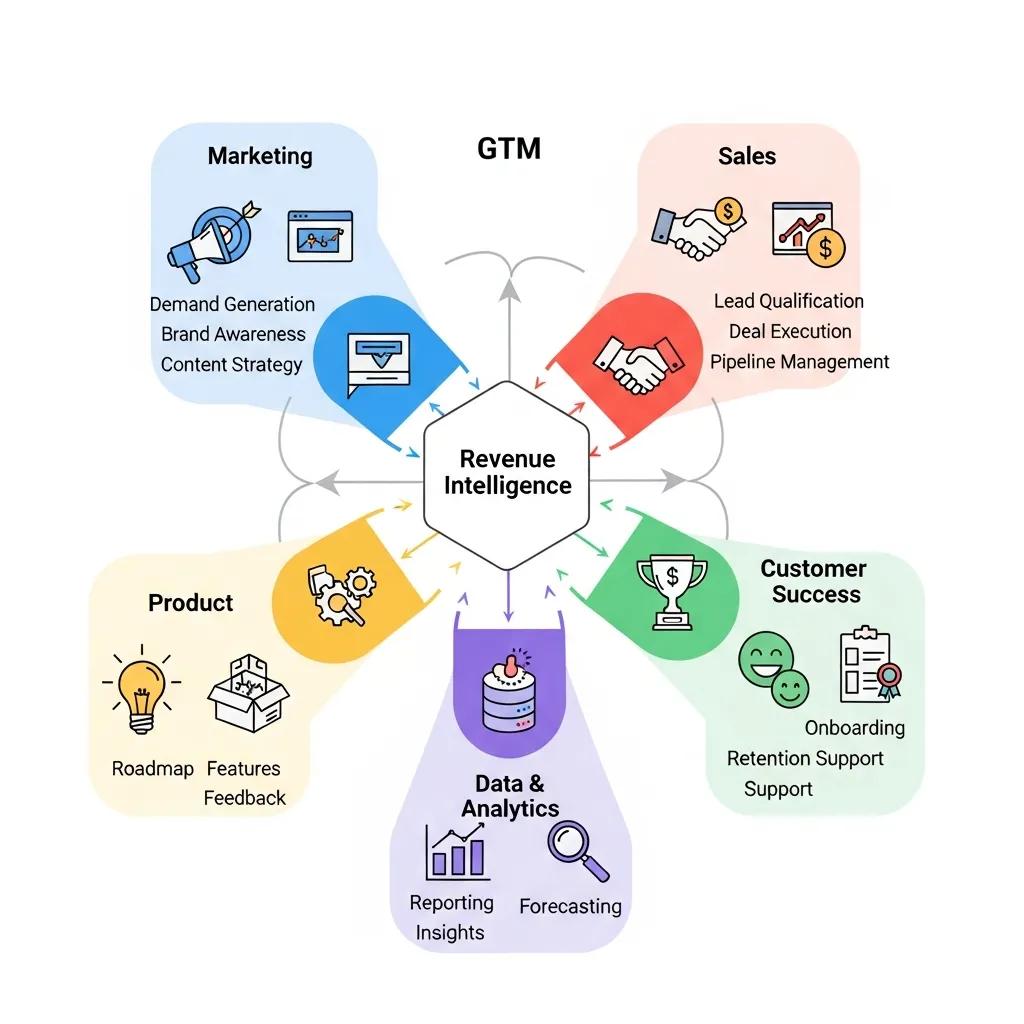
GTM architecture defines how products reach the market — the roles, processes, and technology that keep teams coordinated. A clear GTM framework makes it straightforward to weave revenue intelligence into daily operations so insights guide action rather than gather dust in dashboards.
In industrial and enterprise markets, an effective GTM pairs market insight, precise customer segmentation, and a pragmatic sales motion. These elements help organizations position offerings where they can win and expand.
We map revenue intelligence to GTM architecture so customers can convert insights into measurable revenue gains.
What Are the Core Components of Go To Market Strategy in Industrial Sectors?
A robust GTM strategy typically includes these elements:
- Market Analysis: Identify trends, competitors, and unmet needs to shape positioning.
- Target Audience Identification: Define ideal customer profiles and buyer personas to focus outreach.
- Sales Strategy Development: Build a repeatable sales motion that matches buyer expectations and cycles.
Together, these components help teams prioritize resources and capture market opportunities more effectively.
How Does GTM Alignment Improve Sales and Marketing Collaboration?
When GTM plans are aligned, sales and marketing share goals, metrics, and buyer context — reducing friction and improving outcomes. Aligned teams coordinate messaging, timing, and account prioritization to deliver a consistent customer experience across channels.
Data and joint experimentation let teams convert more leads and grow revenue faster by continuously tuning what works.
What Are Best Practices in Client Success Management for Revenue Growth?

Client success is where retention and expansion happen. Its role is helping customers realize value quickly and consistently — turning satisfied users into repeat buyers and advocates.
Key client success practices include:
- Customer Engagement Strategies: Proactive outreach and regular health checks surface risks and expansion opportunities early.
- Retention Techniques: Tailored onboarding, targeted support, and focused campaigns reduce churn and increase lifetime value.
- Measuring Success: Track CLV, churn, adoption, and other KPIs to link customer outcomes to revenue performance.
These practices make client success a measurable, revenue‑driving function rather than a reactive support center.
How Does Client Success Operations Enhance Customer Retention?
Client success operations scale retention by codifying playbooks, automating touchpoints, and instrumenting health signals. Regular check‑ins, personalized guidance, and timely product communications keep customers engaged and lower churn risk.
Gathering feedback through surveys and interviews lets teams prioritize the product and service improvements that matter most, increasing loyalty and long‑term revenue.
Which Metrics Measure Client Success Impact on Revenue?
To quantify client success impact, focus on a concise set of metrics:
- Customer Lifetime Value (CLV): The expected total revenue from a customer over the relationship.
- Churn Rate: The share of customers lost over a period — a direct signal of retention health.
- Net Promoter Score (NPS): Measures likelihood to recommend and often predicts referral and expansion potential.
Monitoring these KPIs helps teams link customer outcomes to business results and prioritize the highest‑impact initiatives.
How Can Automation and Data Analysis Optimize Revenue Operations?
Automation and data analysis remove manual work, surface actionable signals, and shorten decision cycles. Together, they let teams focus on strategy and customer outcomes instead of cleaning data and repeating tasks.
Automation enables real‑time reporting, trigger‑based workflows, and consistent scoring models, while analysis turns raw data into recommended steps for sales, marketing, and success teams.
What Role Does Automation Play in Revenue Intelligence Platforms?
Automation streamlines data collection, cleans inputs, and delivers timely, accurate reports. That reduces reporting lag and strengthens trust in the numbers. When automation handles repeatable tasks, teams spend more time on account strategy and customer conversations.
Benefits include more accurate reporting, faster response to market changes, and better cross‑team coordination. Organizations must invest in data quality controls and change management to ensure automation delivers dependable outcomes.
How Do Predictive Data Models Support Sales and Marketing Alignment?
Predictive models identify high‑value accounts, forecast likely outcomes, and score leads based on behavior — enabling sales and marketing to prioritize the right opportunities. Using historical patterns, teams can personalize outreach and allocate resources where they’ll have the biggest impact.
When applied to lead scoring and account prioritization, predictive models typically produce higher conversion rates and more efficient pipeline growth.
In short, combining full‑funnel revenue intelligence with GTM architecture and client success operations turns data into repeatable revenue. With unified insights, automation, and the right organizational practices, businesses can make better decisions and sustain growth.
Expanding the Scope: Intelligence and Technology in Revenue Growth
AI and machine learning are reshaping how organizations approach revenue intelligence. AI‑driven software accelerates onboarding, enhances CRM workflows, and increases sales velocity by surfacing timely pipeline signals. These tools give sales teams clearer visibility and faster access to actionable insights.
Machine learning models analyze CRM data to produce sales and conversation intelligence, helping managers and client success teams spot opportunities and risks earlier. Platforms like Clari and Revenue Grid show how predictive models and automation can optimize revenue management and resource allocation.
Enhancing Customer Experience and Satisfaction Through Technology
Customer experience and satisfaction are core revenue drivers. Knowledge bases and chatbots deliver quick answers and reduce workload for client success teams. Marketing automation streamlines lead generation and nurture sequences, increasing demand and strengthening brand presence.
Scalability matters: client success platforms and operations teams use data to monitor churn and CLV, ensuring strategies remain effective and aligned with business goals.
Leadership and Data-Driven Decision Making
Effective leadership depends on accurate analysis and clear insights. Sales operations and ops managers use CRM and sales data to track performance and adapt strategy. Understanding competitive dynamics and pricing helps leaders make decisions that maximize profit and scale operations.
Regular learning initiatives — newsletters, trainings, and playbooks — keep teams current on solutions and best practices. Continuous education supports adoption and fosters a culture of improvement.
Leveraging Salesforce for Full-Funnel Revenue Intelligence
Salesforce is a leading CRM platform that plays a pivotal role in enabling full‑funnel revenue intelligence. By centralizing customer data and integrating sales, marketing, and client success workflows, it provides a unified platform for revenue operations.
With Salesforce, organizations can automate data capture, track customer interactions across channels, and generate real‑time insights that inform decisions. Its ecosystem supports predictive models, AI‑driven insights through Salesforce Einstein, and integrations with marketing automation and client success solutions.
Customizable dashboards and reports empower teams to monitor pipeline health, forecast revenue, and identify expansion opportunities. This alignment improves collaboration and ensures all teams work from a single source of truth.
Salesforce Features That Enhance Revenue Intelligence
- Sales Cloud: Manages sales processes, lead tracking, and opportunity management with automation and AI insights.
- Marketing Cloud: Enables personalized campaigns, customer journey mapping, and performance insights.
- Service Cloud: Supports client success with case management, knowledge bases, and omnichannel support.
- Einstein Analytics: Provides AI‑powered predictive insights and recommendations to optimize sales and marketing efforts.
- Integration Capabilities: Connects with ERP, financial systems, and third‑party applications to unify data flow.
Best Practices for Implementing Salesforce in Revenue Operations
To maximize value, organizations should:
- Define clear data governance policies to maintain quality and consistency.
- Customize objects and workflows to align with GTM architecture and client success processes.
- Train employees thoroughly on features and insights to drive adoption.
- Leverage automation to reduce manual tasks and accelerate response times.
- Continuously monitor and refine dashboards and reports to keep insights actionable.
By embedding Salesforce into full‑funnel revenue intelligence strategies, businesses can improve visibility, strengthen collaboration, and drive predictable growth.
Incorporating Gartner Insights into Revenue Intelligence Strategies
Gartner is a leading research and advisory firm whose frameworks help organizations refine revenue intelligence and GTM strategies. Their research guides decision‑makers in selecting technologies, optimizing processes, and aligning teams for maximum impact.
Gartner’s Magic Quadrant reports evaluate vendors across CRM, marketing automation, and client success platforms, offering a trusted perspective on market leaders and innovators. These evaluations help organizations choose solutions that fit their full‑funnel needs.
Their best practice guides emphasize integrating data sources, fostering cross‑functional collaboration, and adopting predictive models to drive revenue growth. Gartner’s research shows how mature revenue operations correlate with higher growth rates and improved retention.
Applying Gartner’s Revenue Operations Framework
Their revenue operations framework outlines key capabilities for aligning sales, marketing, and client success, including:
- Data Integration and Governance: Ensuring clean, unified data across systems.
- Process Standardization: Defining consistent workflows and handoffs.
- Technology Enablement: Deploying platforms that support automation and analysis.
- Performance Measurement: Tracking KPIs that reflect revenue impact.
- Organizational Alignment: Creating shared goals and accountability.
Organizations that adopt this framework can accelerate revenue intelligence maturity and realize more predictable growth.
Role in Predictive Data Models and AI Adoption
Their research also examines AI and predictive models in revenue intelligence. Gartner helps organizations implement machine learning that improves lead scoring, forecasts outcomes, and personalizes engagement.
Following their recommendations helps companies avoid common pitfalls in AI adoption, such as data bias and lack of transparency, ensuring predictive solutions deliver reliable, actionable insights.
Leveraging HubSpot for Full-Funnel Revenue Intelligence
HubSpot is a comprehensive CRM platform that supports full‑funnel revenue intelligence by unifying marketing, sales, and service in one system. Its user‑friendly interface and automation capabilities make it a popular choice for teams aligning GTM architecture with client success.
HubSpot’s Marketing Hub helps teams create personalized campaigns, track lead behavior, and nurture prospects through automated workflows. The Sales Hub provides pipeline management, email tracking, and predictive lead scoring to help sales prioritize effectively.
On the client success side, HubSpot’s Service Hub offers ticketing, knowledge base management, and customer feedback tools that support retention and expansion. The platform’s unified reporting gives a holistic view of revenue performance and customer health.
HubSpot Features That Drive Revenue Intelligence
- Marketing Automation: Automate email campaigns, lead nurturing, and segmentation to increase engagement.
- Sales Pipeline Management: Visualize deals, track progress, and forecast revenue with real‑time data.
- Customer Service Solutions: Manage support tickets, automate responses, and gather customer feedback.
- Integrated Insights: Combine data from marketing, sales, and service for a comprehensive view.
- App Marketplace: Extend functionality with integrations to ERP, finance, and other systems.
Best Practices for Using HubSpot in Revenue Operations
To fully leverage HubSpot, organizations should:
- Align marketing, sales, and service around shared goals and data definitions.
- Implement automated workflows to reduce manual tasks and improve handoffs.
- Use HubSpot’s reporting to monitor funnel performance and surface bottlenecks.
- Train teams on platform features and data interpretation to maximize adoption.
- Integrate HubSpot with other enterprise systems to ensure data consistency.
By incorporating HubSpot into revenue operations, businesses can improve collaboration, customer engagement, and long‑term growth.
Artificial Intelligence in Revenue Intelligence Platforms
AI is transforming revenue intelligence by unlocking deeper insights and faster decisions. Algorithms analyze large datasets to identify patterns and predict customer behavior, helping teams prioritize efforts more effectively.
Features like natural language processing and sentiment analysis enrich CRM by interpreting communications and feedback. This enables client success teams to address issues proactively and tailor engagement.
AI also powers predictive analytics — forecasting sales trends, churn risk, and expansion opportunities. Integrating AI into revenue intelligence platforms lets organizations move from reactive to proactive revenue management, driving higher growth and stronger customer outcomes.
Customer Success Platforms and Their Role in Revenue Growth
Customer success platforms support client success operations by automating workflows, tracking customer health, and enabling engagement. They centralize CRM, support, and usage data to deliver a comprehensive picture of the customer journey.
Using these platforms, organizations can detect at‑risk accounts early, personalize outreach, and measure how success activities impact lifetime value. Integrating customer success platforms with revenue intelligence creates a seamless flow of insights that aligns client success with predictable revenue growth.
Business Intelligence and Predictive Analytics in Revenue Operations
Business intelligence tools complement revenue intelligence by aggregating and visualizing data from multiple sources, enabling comprehensive analysis of sales, marketing, and client success performance. BI dashboards give leaders real‑time visibility into key metrics and trends.
Predictive analytics applies statistical models and machine learning to forecast outcomes such as churn, pipeline velocity, and revenue. These insights help revenue operations optimize resource allocation and prioritize high‑impact activities.
Combining BI with predictive analytics improves the accuracy and timeliness of revenue forecasts, supporting data‑driven decision‑making and continuous improvement across the revenue lifecycle.
Building an Effective Customer Success Team
An effective customer success team is essential for turning strategy into revenue. The team should be cross‑functional, blending account management, data analysis, and product expertise to deliver tailored customer experiences.
Key responsibilities include onboarding, monitoring health scores, managing renewals, and identifying upsell opportunities. Equipping the team with customer success platforms and CRM integrations enables them to act on revenue intelligence efficiently.
Investing in ongoing training keeps the team aligned with business goals and customer needs, maximizing their impact on lifetime value and overall revenue.
Conclusion
Full‑funnel revenue intelligence, paired with aligned GTM architecture and client success, sharpens decision‑making and accelerates growth. Unified insights, targeted automation, and coordinated teams convert data into predictable revenue. Learn how our tailored solutions can help you streamline revenue operations and unlock sustainable growth.