
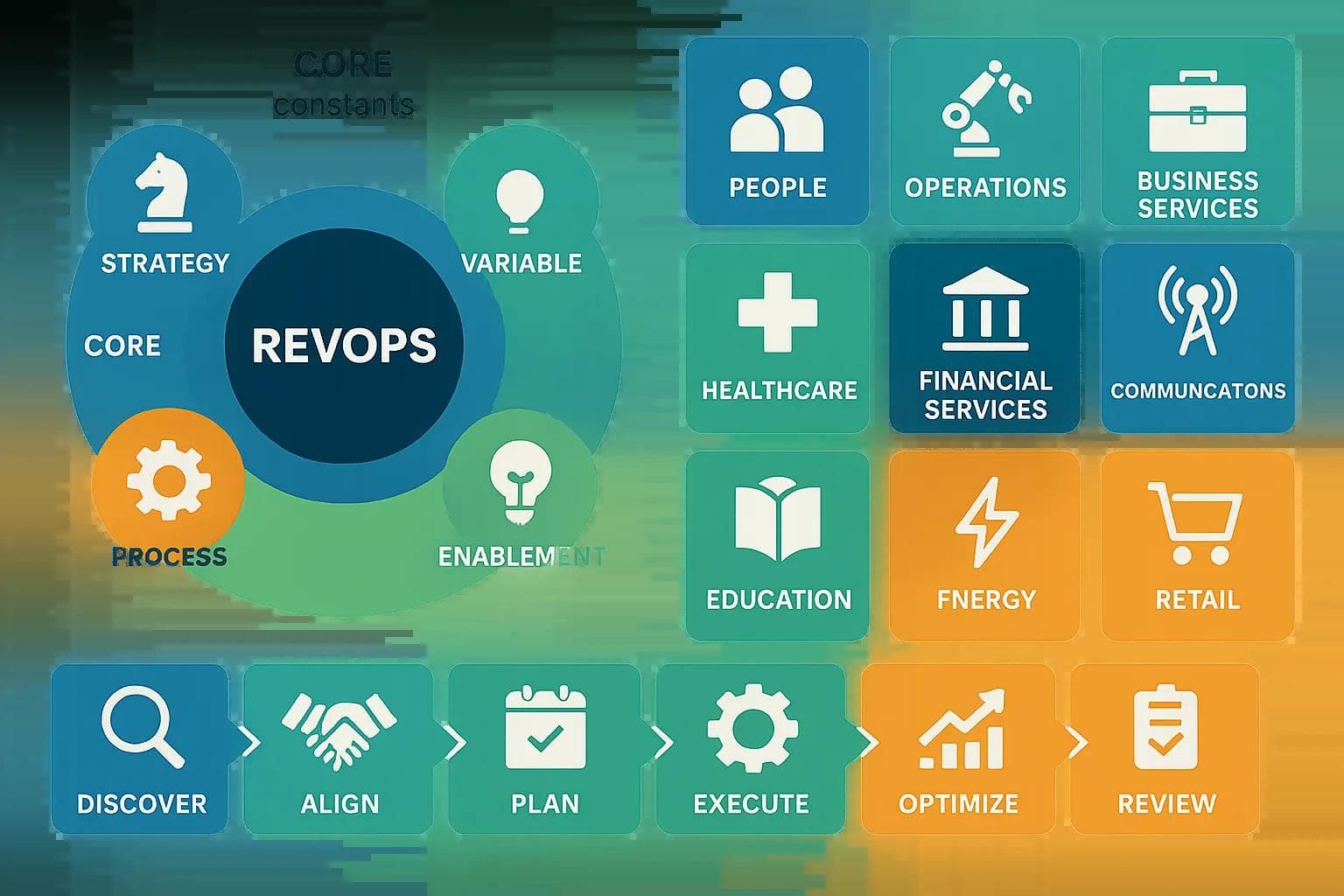
Tailored Revenue Operations by Industry
Revenue Operations (RevOps) brings sales, marketing, and customer success together around one measurable goal: predictable revenue growth. But a high-performing RevOps program must be built around how your industry actually operates. Sales cadence, data sources, buyer behavior, and revenue models vary by vertical — and those differences require custom frameworks. Inveo designs RevOps systems for your industry so processes, data, and reporting drive efficiency, data integrity, and clear profit outcomes, enhancing customer experience and operational efficiency.
Key Takeaways
- RevOps aligns sales, marketing, and customer success for predictable revenue growth and improved customer retention.
- Industry-specific RevOps frameworks outperform generic ones by matching sales cycles, lead management, and buyer patterns.
- Four key variables shape RevOps: sales cycle, buyer behavior, data environment, and revenue model, supported by advanced analytics and artificial intelligence.
- Inveo customizes RevOps systems to create efficient, profitable industry-specific solutions that integrate marketing automation, collaboration tools, and enterprise resource planning.
- Transportation & Logistics RevOps requires carrier enrichment, routing optimization, and lane-level revenue visibility.
- Building Materials RevOps needs multi-tier channel management, project-centered pipeline tracking, and strategic planning.
- Retail RevOps depends on SKU-level insights, seasonal pipeline planning, and digital marketing integration.
- Supply Chain RevOps integrates procurement signals, data governance, and client revenue lifecycles.
- Inveo deploys tailored RevOps systems within 30–60 days with vertical-specific configurations, ensuring data quality and seamless data integration.
Why Industry-Specific RevOps Outperforms Generic Revenue Operations
Most off-the-shelf RevOps frameworks start with SaaS assumptions and get stretched to fit other industries. That mismatch produces broken pipelines, missing data, and faulty assumptions — for example, a freight broker’s revenue cycle rarely maps to a SaaS funnel. Applying a one-size-fits-all playbook without vertical context creates misalignment, friction, and leaves revenue on the table, impacting return on investment and overall business productivity.
Every industry’s RevOps differs because of four core variables:
1. Sales Cycle Structure
- Transactional vs. relationship-driven vs. RFP-led approaches
- How cycle length and complexity determine pipeline architecture and sales management strategies
- Examples: Transportation & Logistics spot quote (hours) vs. Building Materials contract (weeks) vs. Manufacturing capital equipment (months)
2. Buyer Behavior & Decision Architecture
- Single decision-maker vs. buying committee vs. procurement-led approvals
- How B2B buying patterns shift by vertical and what that means for GTM design and lead generation
- Why the same ICP can produce different outcomes across industries, affecting customer acquisition cost and customer lifetime value
3. Data Environment & CRM Requirements
- Industry-specific records: carrier profiles, SKUs, project metadata, contract terms
- Why default CRM setups fail in asset-heavy or relationship-driven sectors
- Enrichment needs by vertical: FMCSA, D&B, industry directories, permit and registry data
- Importance of data governance, data sharing, and maintaining a single source of truth
4. Revenue Model & Retention Dynamics
- Transactional vs. recurring vs. project-based revenue mechanics
- How NRR, churn rate, and expansion behave differently across verticals
- Why Customer Success in Transportation & Logistics looks very different from SaaS, requiring tailored customer success operations and onboarding processes
The Vertical RevOps Framework
We start with a proven RevOps core, then tune the variables to each vertical’s realities. That way every industry benefits from a consistent operating system adapted to its constraints and opportunities, leveraging predictive analytics, machine learning, and agentic AI to optimize revenue streams and improve communication across GTM teams.
The 3 constants across every vertical:
- A clean, enriched data foundation ensuring data integrity and transparency
- A pipeline that mirrors the actual buyer journey and supports sales forecasting
- Full-funnel revenue intelligence powered by analytics and AI-driven insights
The 5 variables customized per vertical:
- ICP definition and account scoring aligned with target market and organizational structure
- Pipeline stage architecture reflecting customer lifecycle management and lead management
- CRM field mapping and data schema supporting marketing automation and operational efficiency
- Automation and enrichment workflows enhancing productivity and reducing manual data entry
- Revenue intelligence dashboard configuration for strategic planning and leadership decision-making
Visual: Inveo Vertical RevOps Adaptation Matrix (core system × industry customization variables)
RevOps by Industry: All Verticals
Below, each industry has a dedicated RevOps framework—built on Inveo’s core 8-pillar system and adapted to that vertical’s sales cycles, data landscape, buyer behavior, and revenue model. Select your industry to review the full framework and explore how technology, governance, and change management drive success.
RevOps for Transportation & Logistics
The Revenue Challenge: Transportation and logistics live in a data-dense, relationship-driven world. Carrier networks, lane pricing volatility, RFPs, spot vs. contract rates, and FMCSA records create revenue dynamics that generic RevOps setups can’t manage effectively.
What Makes Transportation & Logistics RevOps Unique:
- Carrier data enrichment (FMCSA, MC numbers, safety scores, authority status)
- Lane-level revenue intelligence (origin/destination pairs, rate trends, volume by lane)
- Dual-sided relationship management: shipper pipeline + carrier network
- RFP cycle architecture: bid tracking, lane awards, negotiation workflows
- Spot vs. contract rate modeling embedded in the CRM pipeline
- Load board integration and automated quote workflows
- Routing optimization and pricing strategy integration
RevOps for Transportation & Logistics: The Complete Framework →
RevOps for Building Materials
The Revenue Challenge: Building materials flow through layered distribution—manufacturers, distributors, dealers, contractors, and end buyers—which creates multi-tier sales cycles most CRMs aren’t built to manage. Project-based revenue, relationship selling, and seasonality demand a purpose-built system.
What Makes Building Materials RevOps Unique:
- Multi-tier channel management: distributor + dealer + contractor relationships
- Project pipeline tracking: bid, spec, award, delivery cycle management
- Seasonal demand forecasting tied to pipeline architecture
- Contractor and dealer loyalty program data inside the CRM
- Price list management and quote workflow automation
- Territory management and rep performance by channel tier
- Strategic planning and sales ops integration
RevOps for Building Materials Companies: The Complete Framework →
RevOps for Retail
The Revenue Challenge: B2B retail—wholesale, vendor relationships, retail partnerships, and omnichannel distribution—requires tying high transaction volumes to strategic account management. Retail buyers move quickly, expect data, and operate on tight margins that need near-real-time revenue intelligence.
What Makes Retail RevOps Unique:
- Vendor and buyer relationship management at scale
- SKU-level revenue intelligence: sell-through, margin by product line, velocity by account
- Seasonal pipeline forecasting: Q4, back-to-school, promotional cycles
- Omnichannel integration: in-store, e‑commerce, wholesale, marketplaces
- Chargeback and compliance tracking in revenue workflows
- Retail buyer cycle management: line review, planogram, reorder automation
- Digital marketing and marketing automation integration
RevOps for Retail Companies: The Complete Framework →
RevOps for Supply Chain
The Revenue Challenge: Supply chain organizations—3PLs, procurement firms, warehousing—sit between operations and revenue. Their RevOps must fold procurement data, vendor performance, and client revenue cycles into one actionable system.
What Makes Supply Chain RevOps Unique:
- Vendor and supplier relationship management tied to the revenue pipeline
- Procurement cycle tracking: RFQ, bid, award, contract, renewal
- 3PL client revenue architecture: storage, handling, fulfillment revenue by account
- Supply chain disruption signals included in account health scoring
- Vendor performance data captured in CRM: on-time delivery, fill rates, compliance
- Contract renewal forecasting and expansion motion design
- Data management and data governance for operational efficiency
RevOps for Manufacturing
The Revenue Challenge: Manufacturing deals with long, complex cycles—capital equipment sales, OEM relationships, dealer networks, and service contracts require visibility across years of pipeline and post-sale expansion.
What Makes Manufacturing RevOps Unique:
- Capital equipment pipeline: long cycles, many stakeholders, high ACV
- Dealer and distributor network management
- Service contract and parts revenue tracking
- OEM and tier-1 supplier relationship management
- Production capacity signals integrated into revenue forecasting
- Engineering-to-order pipeline architecture
- Integration with enterprise resource planning and revenue recognition systems
RevOps for Manufacturing Companies →
RevOps for Distribution
The Revenue Challenge: Distributors operate on thin margins, high volume, and close customer relationships. RevOps must manage SKU profitability, penetration, and reorder automation at scale.
What Makes Distribution RevOps Unique:
- Account penetration scoring: share of wallet by product category
- Reorder automation and at-risk account identification
- Margin intelligence by SKU, account, and territory
- Vendor rebate tracking in the revenue model
- Unified inside and field sales data
- Collaboration tools and sales team enablement
RevOps for Distribution Companies →
RevOps for Construction
The Revenue Challenge: Construction revenue is project-based and bid-driven. RevOps must connect estimating, project pipelines, subcontractor relationships, and post-project expansion in a single system.
What Makes Construction RevOps Unique:
- Bid and estimating pipeline architecture
- Project-based revenue forecasting
- Subcontractor and vendor relationship management
- General contractor (GC) and owner relationship tracking
- Permit and project data enrichment
- Retainage and payment cycle tracking in revenue workflows
- Change management and training for project teams
RevOps for Construction Companies →
RevOps for Wholesale
The Revenue Challenge: Wholesale requires handling high-volume, low-margin transactions while building account depth. RevOps must automate reorders, surface expansion opportunities, and flag silent churn risks.
What Makes Wholesale RevOps Unique:
- High-volume account management at scale
- Reorder frequency and recency scoring
- Margin compression early-warning systems
- Buyer consolidation risk detection
- Trade show and event pipeline integration
- EDI and order management data surfaced in the CRM revenue layer
RevOps for Wholesale Companies →
RevOps for SaaS
RevOps for Healthcare
RevOps for Healthcare Organizations →
RevOps for Financial Services
RevOps for Financial Services →
RevOps for Professional Services
RevOps for Professional Services →
RevOps for Robotics & Automation
RevOps for Robotics & Automation Companies →
RevOps for Managed IT & MSPs
RevOps for Managed IT & MSP Companies →
RevOps for Staffing & Workforce Solutions
RevOps for Staffing Companies →
RevOps for Real Estate & Commercial Property
RevOps for Real Estate Companies →
How to Know If Your Industry Needs a Custom RevOps System
Six clear signals that your vertical needs an industry-specific RevOps — not a generic framework:
- Your CRM lacks fields for your most important data (carrier MC numbers, bid dates, SKU margins, lane pairs), impacting data management and data quality
- Your pipeline stages don’t match the actual sales cycle (you’ve forced a SaaS-style funnel onto a relationship-driven model), causing friction and poor sales management
- Marketing and sales define the ICP differently (no shared, vertical-specific account scoring), reducing collaboration and lead generation effectiveness
- Your forecast relies on gut, not pipeline data (no industry-calibrated conversion rates or cycle benchmarks), undermining sales forecasting and strategic planning
- You can’t spot at-risk accounts before they churn (no vertical-specific health scoring), affecting customer retention and customer success teams
- Your tech stack was built for a different industry (tools designed for SaaS running a freight brokerage or building materials distribution), limiting technology adoption and operational efficiency
Book a free vertical RevOps assessment with Inveo — we’ll pinpoint exactly where your industry-specific revenue gaps live and recommend the best tools and methodologies for your organization.
The Industry-Specific RevOps Build Process
Step 1: Vertical Revenue Audit
- Map your current sales cycle to industry benchmarks
- Identify vertical-specific CRM data gaps and data entry issues
- Assess GTM alignment with your industry’s buyer behavior and organizational structure
Step 2: Industry Data Model Design
- Create the CRM schema for your vertical: custom fields, objects, relationships
- Define industry-specific enrichment sources and data sharing protocols
- Map data flow from first touch through closed revenue, ensuring a single source of truth
Step 3: Vertical Pipeline Architecture
- Design pipeline stages that reflect the buyer journey and customer lifecycle management
- Build stage-specific automation and data capture rules to improve productivity and reduce manual tasks
- Set conversion rate benchmarks based on industry standards and predictive analytics
Step 4: Industry Intelligence Layer
- Build revenue intelligence dashboards tuned to your vertical KPIs and strategic goals
- Configure health scoring with relevant industry signals and machine learning insights
- Deploy forecasting models using vertical conversion benchmarks and scenario planning
Step 5: Automation & Enablement
- Build industry-specific automation workflows integrating marketing automation and sales enablement tools like Salesforce, HubSpot, and Salesloft
- Roll out vertical sales playbooks and enablement content aligned with training and development programs
- Set up demand generation aligned to your industry’s buyer behavior and digital marketing strategies
Step 6: Ongoing Vertical Optimization
- Monthly RevOps reviews synced to your revenue cycle and organizational goals
- Quarterly comparisons against vertical benchmarks and compound annual growth rate targets
- Continuous automation and process expansion as your system matures, fostering a culture of accountability and learning
Key Metrics and KPIs


To effectively measure the success of RevOps initiatives, organizations must focus on key performance indicators (KPIs) that reflect their operational efficiency, data integrity, and revenue growth. These metrics can vary significantly across industries, but some common KPIs include:
- Sales Metrics: These metrics assess the effectiveness of sales strategies and include measures such as conversion rates, average deal size, sales cycle length, and sales forecasting accuracy.
- Marketing Alignment Metrics: These indicators evaluate how well marketing efforts support sales objectives, including lead generation rates, marketing-qualified leads (MQLs), and marketing automation effectiveness.
- Customer Success Metrics: These metrics focus on customer retention, satisfaction, and customer experience, measuring factors like churn rate, net promoter score (NPS), customer lifetime value (CLV), and customer acquisition cost.
Understanding these metrics allows organizations to make data-driven decisions that enhance their RevOps strategies. By continuously monitoring and analyzing these KPIs with advanced analytics and artificial intelligence, businesses can identify trends, optimize their processes, and ultimately drive revenue growth and improve return on investment.
The evolution of B2B MarTech, particularly with AI-driven capabilities, is fundamentally reshaping how businesses approach customer engagement, revenue generation, and strategic planning.
B2B MarTech for AI-Driven Revenue Generation
The landscape of B2B marketing technology (MarTech) has undergone a seismic transformation, evolving from fragmented automation tools into intelligent, AI-driven ecosystems that redefine customer engagement, sales enablement, and revenue generation. As businesses navigate the complexities of digital transformation, the integration of Predictive Intelligence (PI) and AI-powered analytics has emerged as a strategic imperative. No longer limited to campaign automation, MarTech now orchestrates seamless, data-driven interactions across the entire corporate value chain. This evolution has not only reshaped how organizations approach customer relationship management (CRM), content personalization, and omnichannel marketing but has also driven the rise of Generative Experience Optimization (GenEO) and AI-fueled decision-making frameworks that anticipate market shifts and buyer behavior with unprecedented accuracy.
The B2B MarTech: The 2030
Edition, U Seebacher, 2030
This table illustrates the importance of tracking these key metrics to ensure that RevOps strategies are effectively contributing to overall business success and operational efficiency.
Industry RevOps Comparison: Key Metrics by Vertical
Frequently Asked Questions
What are the key benefits of implementing a tailored RevOps system?
A tailored RevOps system aligns sales, marketing, and customer success on shared data and repeatable processes. The outcome is clearer handoffs, fewer manual tasks, and more reliable forecasting. When workflows match an industry’s sales cycle and buyer behavior, teams reduce churn, increase efficiency, and create predictable expansion paths, improving customer satisfaction and organizational productivity.
How can I assess if my current RevOps system is effective?
Start with core KPIs: revenue growth, retention, sales cycle length, and forecast accuracy. Verify that your CRM captures the industry-critical fields and that pipeline stages mirror the true buyer journey. Regular audits reveal gaps in data, process, or ICP alignment across teams, highlighting areas for improvement in data governance and technology adoption.
What role does data enrichment play in RevOps?
Data enrichment improves the accuracy and actionability of your revenue signals. External sources add context — carrier records, permits, supplier performance, SKU metrics — so forecasts and playbooks reflect reality. In complex verticals like transportation, enrichment turns noisy data into usable intelligence, supporting predictive analytics and machine learning applications.
How do I choose the right technology stack for my industry-specific RevOps?
Pick tools that are flexible, integratable, and configurable to your data model. Look for platforms that let you model industry entities and workflows — Zoho CRM is a strong option for vertical RevOps because it supports deep customization and integrations. Prioritize scalability, data integration, and the ability to connect enrichment sources, including Salesforce, HubSpot, and Salesloft.
What are common pitfalls when implementing a generic RevOps framework?
Typical pitfalls include mismatched pipeline stages, missing industry data, and low user adoption. Generic frameworks often overlook vertical nuances, which leads to bad assumptions, inaccurate forecasts, and stalled processes. The result is wasted effort, missed revenue, and poor return on investment.
How can I ensure continuous improvement in my RevOps processes?
Make reviews routine: monthly performance checks, quarterly benchmarks, and a feedback loop across revenue teams. Use data to test and refine automations, scoring, and forecasting. Stay current with industry trends and expand automation as the system matures, fostering a culture of accountability, learning, and strategic planning.
Does every industry need a different RevOps system?
Some RevOps principles are universal, but most industries need vertical-specific adjustments to reach peak performance. Gartner finds that aligning RevOps to industry nuances improves predictability and operational efficiency (Gartner).
Can I use a SaaS RevOps framework for my industry?
Generic SaaS frameworks often break down outside of software businesses. Customization matters. Forrester’s research shows vertical-specific RevOps delivers higher ROI and better cross-functional alignment (Forrester).
How long does it take to build an industry-specific RevOps system?
Inveo typically deploys tailored RevOps systems in 30–60 days, depending on vertical complexity and existing infrastructure. This timeline aligns with common CRM customization and integration projects (Salesforce).
What CRM is best recommended for industry-specific RevOps?
Zoho CRM is a preferred choice for its flexibility and customization capabilities. G2 reviews highlight Zoho’s strengths in configurable workflows and integrations — traits essential for vertical RevOps (G2 Crowd).
How is vertical RevOps different from a generic RevOps consultant?
Inveo delivers practitioner-led, vertical-specific expertise that adapts core RevOps systems to industry realities instead of applying a generic template. RevOps.org emphasizes the value of domain experience in successful revenue operations (RevOps.org).
Book Your Free Industry RevOps Audit
Discover how a tailored RevOps strategy can transform your revenue operations, improve customer experiences, and drive sustainable growth.
Your industry has a revenue operations gap.
Inveo has the answers to close it.
Generic RevOps frameworks are designed for SaaS. Inveo builds revenue operations systems tailored to your industry’s sales cycles, data environment, and buyer behavior — deployed in 30–60 days with a focus on data integrity, operational efficiency, and customer success.
Explore your industry’s RevOps framework below ↓
Conclusion
A tailored RevOps framework increases efficiency, data quality, and profitability by aligning sales, marketing, and customer success to your industry’s realities. With Inveo’s vertical expertise, your RevOps strategy will mirror the sales cycles, data flows, and buyer behaviors that matter. Book a free vertical RevOps assessment and see how we can transform your revenue operations for sustained growth, improved customer satisfaction, and enhanced organizational collaboration.